
AMERICAN FICTION Special Literary Event
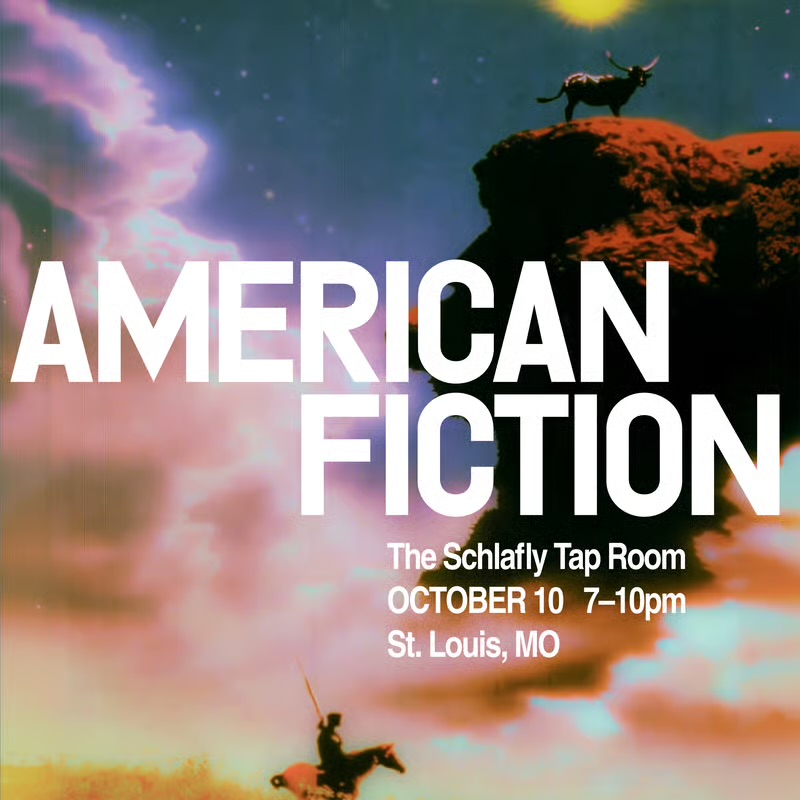
Saturday, October 10, 2026 · 7:00 PM–10:00 PM CDT
The Schlafly Tap Room, 2100 Locust St, St. Louis, MO 63103, USA
Fiction of the American heartland featuring Theodore Judson of ARK Press (author of Fitzpatrick's War and The Timerman), John Jay Stancliff of Farthest Heaven (author of FEDBOOK), and more. Optional drinks Friday, October 9 at Thaxton Speakeasy (1009 Olive St). Afterparty drinks at Brennan's (316 N Euclid Ave). Ticket includes two drink tickets. Hale Room on second floor.
More about the event and why someone might want to go:
The clearer picture is that this is not simply a conventional science-fiction book event. It appears to sit inside a small, self-consciously “dissident” literary ecosystem: independent publishers, online commentators, and podcasters interested in hierarchy, tradition, masculinity, religion, national identity, and critiques of liberal modernity.
A correction to my earlier answer: John Jay Stancliff did not necessarily receive a “Pierce.” Pierce is his second novel, following FEDBOOK. The event wording seems to mean “this year’s Pierce,” not an award. Also, Farthest Heaven’s own material identifies its founder as Bill Ballard, while your listing says Will Ballard—possibly a typo or a different person.
Theodore Judson
Judson is the most conventionally established literary figure in the group. He is a Wyoming-based science-fiction writer and former high-school teacher, best known for Fitzpatrick’s War, a “future history” about the Yukon Confederacy, a successor state to the United States. The Timerman returns to that setting.
The ideological interest comes mainly from the fictional society Judson depicts. The Yukon Confederacy is described as:
- aristocratic and governed through a limited franchise;
- religiously Reformed Protestant;
- economically autarkic;
- oriented toward the common good rather than wealth accumulation;
- socially regulated through stigma and strong communal norms.
The book also raises explicitly political and religious questions, including whether Christians have positive obligations toward foreigners. Those are themes about authority, social cohesion, hierarchy, national community, and the limits of universal humanitarianism. But it would be too strong to conclude from the novel alone that Judson personally endorses every feature of the Yukon Confederacy.
John Jay Stancliff
Stancliff is a newer, more overtly “cult” or subcultural author. His first novel, FEDBOOK, was released by Farthest Heaven; his second, Pierce, is presented as a multigenerational story involving Montana, the Iraq War, masculinity, family, work, inheritance, and reconciliation. Farthest Heaven markets Pierce as “a knight’s tale in the modern age,” which signals a deliberately traditional, chivalric, and anti-ironic frame.
The available evidence does not establish a precise political doctrine for Stancliff. What can be said is that his work is being positioned against contemporary literary norms: it emphasizes male protagonists, military experience, regional identity, moral seriousness, family continuity, and older heroic ideals.
Bill/Will Ballard and Farthest Heaven
Ballard appears to be the organizer, publisher, and network-builder. Farthest Heaven is not just a bookstore or ordinary literary press: it publishes authors such as Stancliff and promotes a broader literary-cultural project. Its connection to Book Club From Hell is especially significant because the podcast has featured episodes on FEDBOOK and Farthest Heaven itself.
The press’s apparent niche is fiction for readers dissatisfied with mainstream publishing—particularly readers seeking books centered on men, tradition, warfare, religious or civilizational questions, and alternative political imaginaries. That does not automatically make every book or person “extremist,” but it does place Farthest Heaven closer to the online heterodox or dissident-right literary world than to mainstream speculative fiction.
The Prudentialist
The Prudentialist is the least transparent figure here. He or she is presented under a pseudonym, hosts a podcast, and serves as emcee. I would not assign a specific ideology without primary material directly identifying the person’s views.
The name “Prudentialist” suggests an interest in practical political judgment rather than abstract egalitarian or revolutionary theories, but that is only an inference from the branding. The important point is that the emcee is part of the same media circuit as these publishers and podcasts, not a neutral literary moderator in the usual institutional sense.
Book Club From Hell
This partnership provides the strongest clue about the event’s cultural atmosphere. Book Club From Hell describes itself as a book club for “the weirdest book club on the planet,” and its episode list ranges from C. S. Lewis, Oswald Spengler, Ernst Jünger, and Ivan Illich to highly provocative, extremist, obscene, conspiratorial, or deliberately transgressive material. It has also hosted discussions with Stancliff and Ballard.
That programming suggests an audience interested in taboo-breaking, anti-establishment ideas, dark or marginal literature, and intellectual provocation. Discussing a book does not mean endorsing it, but the selection of texts shows that transgression and ideological heterodoxy are part of the appeal.
What connects them?
The strongest common threads appear to be:
- Independent publishing outside the mainstream literary establishment.
- A preference for serious, masculine, heroic, or civilizational themes.
- Interest in tradition, religion, hierarchy, nationhood, and social cohesion.
- Suspicion of liberal individualism and contemporary cultural orthodoxies.
- A deliberate willingness to discuss unfashionable, controversial, or taboo works.
- A shared audience built through podcasts, small presses, online communities, and in-person events.
Ark Press reinforces that picture. Its launch materials describe a “Great American Male Reader” and feature books involving guns, military conflict, Confederate gold, American historical mythology, Mars revolution, and adventure aimed particularly at young men. That is not proof of a single political platform, but it is a clear cultural positioning.
Why would anyone attend?
A person might attend because they:
- genuinely like Judson’s science fiction and want to hear about The Timerman;
- want to discover fiction unavailable through mainstream publishing;
- are interested in traditionalist, religious, nationalist, or post-liberal ideas;
- enjoy literary communities built around controversy and outsider status;
- want to meet authors and publishers directly;
- are curious about how online “dissident” intellectual networks are turning toward fiction and publishing.
The event may also appeal to someone studying the contemporary right culturally rather than electorally: how political ideas are communicated through novels, podcasts, historical myth, masculinity, religion, and alternative publishing.
The reason to be cautious is that the event’s value depends heavily on what you want. If you want a neutral author talk or mainstream literary criticism, this probably is not it. If you want to understand or participate in a small reactionary/heterodox literary scene, it could be unusually revealing. The most intellectually worthwhile approach would be to attend skeptically: ask how much of the fictional social order is meant as critique versus aspiration, what “tradition” is being defended, who is excluded from the imagined community, and whether the organizers are offering substantive ideas or mainly cultivating an oppositional identity.